
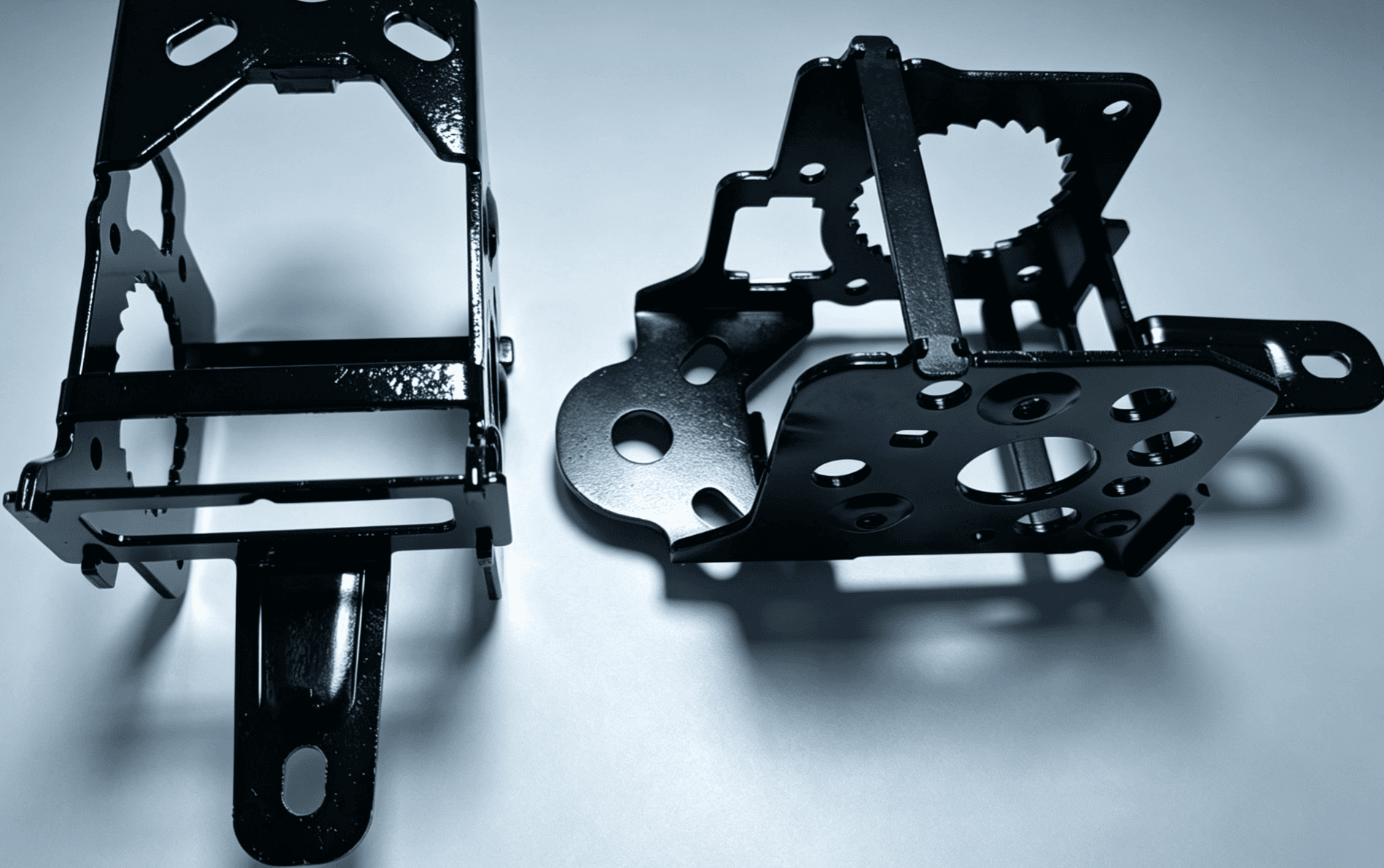
What the seat frame bracket actually demands from a stamping supplier
A seat frame bracket is not a flat washer with holes. It is a structural interface between the seat cushion or back frame and the vehicle floor or recliner mechanism. It carries occupant load, ties into welded assemblies, and must fit a hole pattern that other suppliers also build to. That combination makes supplier evaluation less about press tonnage and more about whether the supplier can hold a formed and welded geometry across a production run.
The bracket family shown in typical automotive samples includes serrated cut-outs, slotted tabs, a mounting hole pattern, and welded cross members, usually with a coated finish. Each of those features creates a different failure mode: a serration that is not fully sheared, a slot that drifts during forming, a hole pattern that shifts after welding, or a coating that hides a surface defect. Your supplier evaluation should map to those failure modes rather than to a generic quality questionnaire.
This guide is written for a buyer moving from consideration to supplier evaluation. It covers the criteria that separate capable stamping suppliers from assemblers, the questions to ask, the sample and first-article evidence to request, and the procurement risks to close before a purchase order.
Start with the drawing and the process route, not the price
Before comparing suppliers, confirm what you are actually buying. A seat frame bracket can be delivered as a single stamped part, a stamped part with secondary welding, or a welded subassembly with cross members. Those are different scopes, and a quote is only comparable when the scope matches.
Ask each candidate to return a process route with the quote: blanking, forming or drawing, trimming, piercing, welding, coating, and inspection steps, in sequence. The route tells you where the supplier expects variation to enter. A supplier that lists welding as an in-house step and can describe the fixture that controls cross-member position is giving you more useful information than one that lists a press tonnage.
Scope questions that change the comparison
- Is the bracket supplied as a single stamping, or with welded cross members included?
- Who owns the tooling, and who maintains it over the program life?
- Which operations are in-house and which are subcontracted, especially coating and heat treatment?
- Is the hole pattern checked on the finished welded part or only on the stamped component?
- What reference document governs acceptance: the customer drawing, a control plan, or a first-article report?
If a supplier cannot state its process route in writing, treat the quote as provisional. The route is also the basis for later change control: a supplier that adds a welding step after award without telling you has changed the part, even if the drawing has not changed.
Selection criteria that predict production performance
The criteria below are ordered by how often they cause problems after award, not by how easy they are to audit. Use them to build a scored comparison rather than a pass/fail list; a supplier can be strong on tooling and weak on coating traceability, and you need to see that trade-off.
| Criterion | What good evidence looks like | Risk if weak |
|---|---|---|
| Tooling capability and ownership | Tool design review, tool maintenance interval, clear ownership and transfer terms | Tooling locked to one supplier; replacement cost and delay at end of program |
| Forming and drawing control | Documented forming parameters, in-process checks on critical dimensions | Springback and slot drift; fit problems at the seat assembly |
| Welding control for cross members | Welding fixture description, weld schedule control, position checks after welding | Hole pattern distortion; cross-member misalignment |
| Hole pattern and datum control | Datum scheme stated on the drawing and reflected in the inspection plan | Bracket will not bolt to the frame or floor interface |
| Coating and finish | Coating specification, thickness or appearance checks, sub-supplier identification | Corrosion or appearance rejects; hidden surface defects |
| Measurement capability | Inspection equipment list, gauge repeatability practice, first-article report format | Disputes over whether a part conforms |
| Change control | Written approval process for process, material, or sub-supplier changes | Silent changes that invalidate validation |
| Capacity and scheduling | Press and welding capacity stated in parts per period, with current loading | Late delivery during model ramp |
Two criteria deserve more attention than they usually get. First, datum control: a bracket with a hole pattern is only as good as the datum scheme used to inspect it, and suppliers that inspect from a different datum than the drawing will report conforming parts that do not fit. Second, change control: a supplier that treats coating sub-supplier changes as routine is a supplier that can invalidate your validation without a drawing change.
Tooling: the decision that outlasts the quote
Tooling is where procurement risk concentrates. The tool determines the formed geometry, the hole pattern position, and the maintenance burden for the life of the program. Ask for a tool design review before award, not after. The review should cover the number of stations, how the serrated cut-outs and slots are produced, how the part is located in each station, and how the tool is maintained.
Ownership and transfer terms matter as much as the tool design. Confirm in writing who owns the tool, who pays for maintenance and refurbishment, what condition the tool must be returned in, and what the supplier will provide if you move the part to another stamping manufacturer. A supplier that hesitates on transfer terms is telling you something about lock-in.
Tooling questions to put in writing
- How many forming stations, and which station produces the serrated cut-outs and slotted tabs?
- How is the hole pattern located, and is it produced before or after welding?
- What is the planned maintenance interval, and what triggers a refurbishment?
- If we transfer the part, what tooling documentation and spare details come with it?
- What is the expected tool life, and how is that estimate supported?
Do not accept a tool life figure without the basis for it. If the supplier cannot explain how the estimate was derived, treat it as a planning assumption rather than a commitment.
Welding and coating: the steps most often subcontracted and least often checked
Seat frame brackets with cross members involve welding, and welding is where a stamped part becomes an assembly. The critical question is not whether the supplier can weld, but whether the supplier controls position after welding. Welding heat distorts thin sections, and a hole pattern that was in tolerance before welding can move afterward. Ask how the welding fixture locates the part, and whether the hole pattern is checked on the welded assembly.
Coating is the other commonly subcontracted step. A coated finish can hide surface defects and can vary between sub-suppliers. Ask who coats the parts, what specification governs the coating, and how the supplier verifies it. If the coating sub-supplier is not identified, you cannot assess the risk.
The same logic applies to deep-drawn components in the seat assembly, such as drawn sleeves or housings. Deep drawing forms the wall from one blank, so the body has no weld seam, but the drawn geometry still depends on tooling and process control. If your bracket program includes drawn parts, evaluate the drawing capability separately from the stamping capability.
Sample and first-article validation: what to request and how to read it
Samples are necessary but not sufficient. A supplier can produce a good sample from a tool that is not yet stable. The purpose of sample validation is to confirm that the supplier can measure and document the part, not just make one.
Request a first-article report that shows every drawing dimension, the datum scheme used, the measurement method, and the result. Read it for what is missing: a report that omits the hole pattern position or the cross-member location is not a first-article report for this part. Ask for the inspection plan that will be used in production, and compare it with the first-article report. If the production plan checks fewer features than the first article, ask why.
Validation steps in order
- Drawing and datum review with the supplier's quality and tooling engineers present.
- Tool design review before tool build.
- First-article inspection on parts from the production tool, not a prototype tool.
- Fit check in your seat assembly or a representative fixture.
- Run-at-rate or pilot lot to confirm the process holds across a run.
- Written confirmation of the production inspection plan and change control process.
Do not skip the fit check. A bracket can meet every drawing dimension and still fail at assembly if the datum scheme does not match how the part is used. The fit check is where drawing and reality meet.
Procurement risk checklist
Use this checklist as a gate before award. Each item should have a named owner on the supplier side and a document you can file.
| Risk area | Check | Evidence to file |
|---|---|---|
| Scope | Quote matches the drawing scope, including welding and coating | Signed scope statement |
| Tooling | Ownership, maintenance, and transfer terms agreed | Tooling agreement |
| Datum and inspection | Datum scheme matches the drawing; inspection plan covers hole pattern and cross members | Inspection plan and first-article report |
| Welding | Fixture locates the part; position checked after welding | Welding control description |
| Coating | Sub-supplier identified; specification and verification stated | Coating specification and check method |
| Change control | Written approval required for process, material, or sub-supplier changes | Change control procedure |
| Capacity | Capacity stated in parts per period with current loading | Capacity statement |
| Contingency | Plan for tool repair, press downtime, and coating sub-supplier interruption | Contingency plan |
Two checklist items are commonly skipped and commonly cause problems. The coating sub-supplier check is skipped because coating looks like a commodity step; it is not, because a coating change can alter fit and appearance. The contingency check is skipped because it feels pessimistic; it is the difference between a supplier that tells you about a press breakdown and one that ships late without warning.
Warning signs during supplier evaluation
Some signals are worth acting on before you spend time on a full audit.
- The supplier quotes a bracket without asking about the datum scheme or the welding scope.
- The process route lists welding but cannot describe the fixture.
- The first-article report shows results without measurement methods.
- The supplier cannot name the coating sub-supplier or the coating specification.
- Tool ownership and transfer terms are described as something to sort out later.
- Capacity is stated only as press tonnage, not as parts per period.
- Change control is described verbally but not documented.
None of these is automatically disqualifying. A supplier that answers them clearly when asked is showing you how it will behave during the program. A supplier that deflects is showing you the same thing.
Questions to ask before you place the order
Bring a short list to the supplier evaluation meeting and ask for written answers. The answers become part of the award record.
- Can you walk us through the process route for this bracket, station by station?
- How do you locate the hole pattern, and do you check it after welding?
- Who owns the tool, and what happens if we transfer the part?
- Which operations are subcontracted, and who are the sub-suppliers?
- What does your first-article report include, and can we see a sample report?
- What is your change control process, and who approves changes?
- What capacity is committed to this program, and how is it protected?
The quality of the answers matters less than their consistency with the documents you later receive. A supplier whose written answers match its first-article report and inspection plan is a supplier you can manage. A supplier whose answers drift between meetings is a supplier you will spend the program chasing.
Next steps for the buyer
Move from evaluation to award in a defined sequence: confirm scope, review tooling, validate the first article, run a fit check, and file the risk checklist with named owners. Keep the process route and inspection plan as living documents, and revisit them at every engineering change. The goal is not to find a supplier that promises the most; it is to find one whose evidence you can verify and whose process you can audit after the order is placed.